
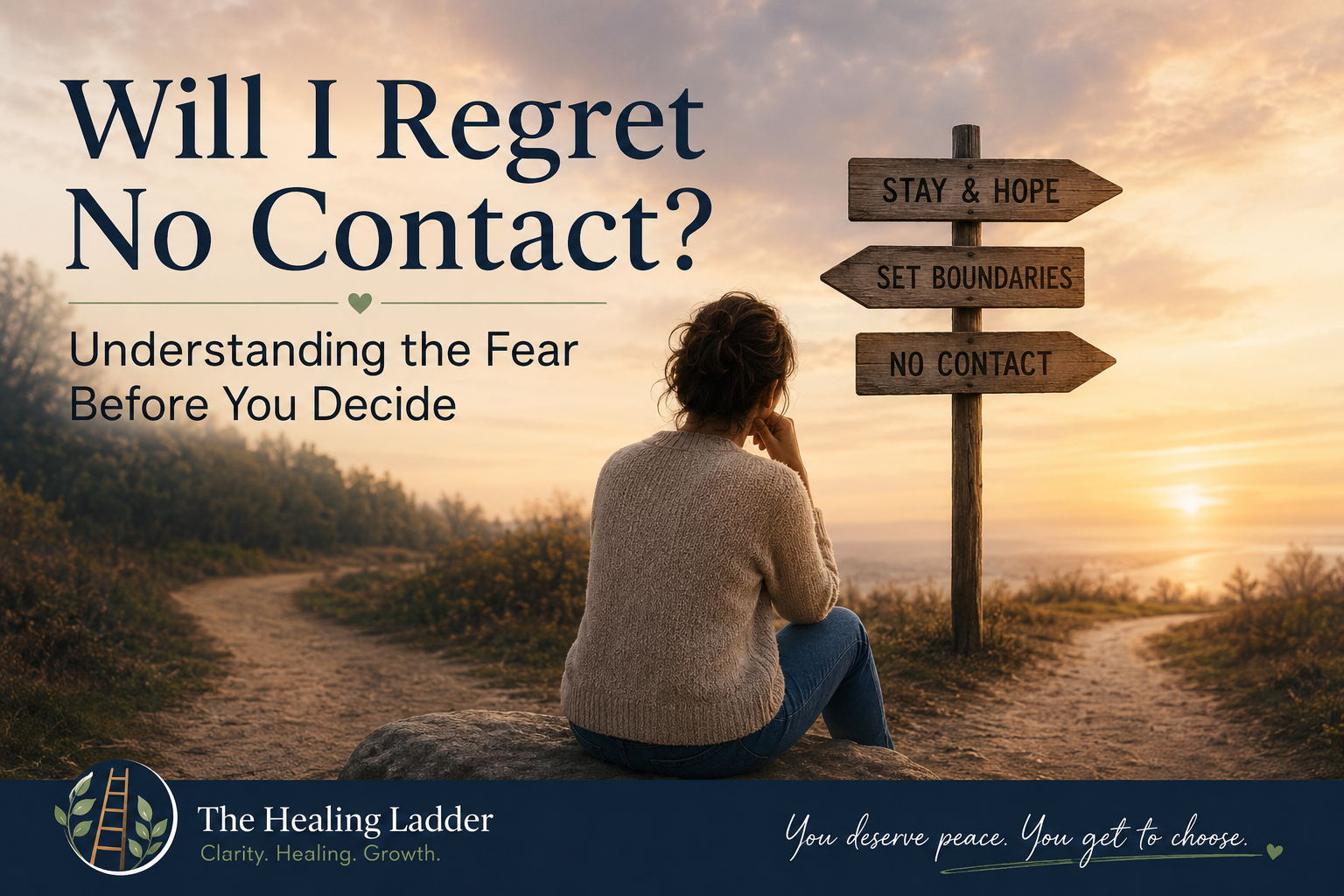
If you’re asking yourself, “Will I regret no contact?”, you’re probably carrying more than one emotion at once. There may be relief at the thought of distance, guilt about what others might think, sadness for the relationship you wished you had, and fear that you’re making a mistake you cannot undo.
These mixed feelings are incredibly common.
Many people assume that deciding to go no contact with a parent, sibling, or other family member should feel obvious if it is the “right” choice. In reality, research on family relationships, attachment, and grief suggests almost the opposite. Difficult family decisions often involve conflicting emotions because they touch our deepest needs for connection, belonging, and safety.
The question is often not whether you will feel regret at some point. The better question is whether temporary regret means the decision was wrong.
Understanding why regret happens—and how to distinguish emotional discomfort from genuine mistakes—can help you make a decision that aligns with your own wellbeing rather than fear.
Why the Fear of Regret Feels So Powerful

Humans are wired to think ahead.
Psychologists describe regret as an emotion that helps us learn from past decisions and avoid future harm. Our brains naturally imagine alternative outcomes:
- What if I waited longer?
- What if they finally changed?
- What if I regret losing them forever?
This mental simulation can be useful when choosing between two jobs or deciding where to live.
Family relationships are different.
Unlike many other choices, family relationships involve lifelong emotional bonds that begin before we have language. According to attachment theory, our earliest caregivers shape our expectations about safety, closeness, and connection throughout life.
Even when a relationship becomes emotionally unsafe, our attachment system often continues searching for closeness.
This is why someone can simultaneously think:
- “I can’t keep doing this.”
- “I don’t want to lose them.”
- “Maybe things will finally improve.”
These thoughts are not evidence that you should stay. They are evidence that you are human.
Regret Is Not the Same as Missing Someone
One of the biggest misconceptions about no contact is that missing a family member automatically means you made the wrong decision.
It doesn’t.
You can miss:
- the good memories
- family traditions
- holidays
- the hope of reconciliation
- the version of them you wish existed
- the role they were supposed to play in your life
None of these necessarily mean the relationship was healthy.
Research on grief shows that people often mourn not only what they lost but also what they never had. This is sometimes called ambiguous loss—a type of grief that occurs when someone is physically present but emotionally unavailable, or when the relationship itself never matched what you needed.
No contact can bring this grief into sharper focus because distance removes the possibility that tomorrow will finally be different.
That grief deserves compassion rather than judgment.
Why Guilt Often Feels Like Regret
Many people mistake guilt for regret.
Although they can overlap, they are different experiences.
Guilt says:
“I did something wrong.”
Regret says:
“I wish I had made a different decision.”
Sometimes, after going no contact, what people experience is not regret about protecting themselves but guilt about breaking family expectations.
Family systems often develop spoken and unspoken rules, such as:
- Family comes first.
- Parents should always be respected.
- Forgiveness is required.
- Good children stay connected.
If these beliefs were reinforced throughout childhood, choosing distance may trigger intense guilt even when the decision protects your emotional health.
Feeling guilty does not automatically mean you acted unfairly.
Sometimes it simply means you violated expectations that no longer serve your wellbeing.
Your Brain May Focus More on the Good Times
After creating distance, many people notice their minds replay positive memories.
This is completely understandable.
The brain does not store memories like a video recording. Memory is selective and influenced by emotion.
During periods of loneliness or uncertainty, people often remember:
- birthdays
- vacations
- moments of kindness
- laughter
- ordinary family routines
Meanwhile, repeated patterns of criticism, manipulation, unpredictability, or emotional neglect may fade temporarily into the background.
This doesn’t mean those harmful experiences never happened.
Some people find it helpful to gently remind themselves why they considered no contact in the first place.
Looking back at journal entries, written conversations, or notes made before creating distance can provide a more balanced picture than relying only on memories shaped by emotion.
Will You Regret No Contact If They Change?
This question often hides a deeper hope.
“What if they finally become the parent, sibling, or relative I’ve always wanted?”
People can change.
Relationships can improve.
Reconciliation is possible in some families.
However, lasting change usually involves consistent behavior over time rather than promises, apologies, or brief periods of improvement.
Psychological research on behavior change consistently shows that sustainable change tends to require ongoing motivation, accountability, and repeated practice.
Rather than asking:
“What if they change?”
It may help to ask:
“What evidence would help me believe lasting change has actually occurred?”
This keeps the focus on observable behavior rather than hope alone.
No Contact Does Not Have to Mean Forever
One reason people fear regret is the belief that no contact is irreversible.
In reality, every situation is different.
Some people remain no contact permanently.
Others later choose:
- low contact
- structured communication
- occasional updates
- carefully defined boundaries
- supervised visits involving children
Some reconnect after years.
Others discover that distance continues to feel healthiest.
There is no universal timeline.
Viewing no contact as a decision that can be revisited—rather than a life sentence—sometimes reduces the pressure to know the future with certainty.
You only have to make the best decision with the information you have today.

Common Reasons People Do Regret No Contact
Although many people report greater peace after creating distance, genuine regret can happen.
Understanding why may help you make a more informed decision.
Some people regret no contact because they acted during an intense emotional crisis without giving themselves time to think.
Others regret not communicating their boundaries clearly before ending contact, especially if there was realistic potential for healthier interaction.
Some regret arises after the death of a family member, when opportunities for future conversations disappear.
Others realize they wanted distance rather than complete separation.
These experiences remind us that no contact is not the only option.
Boundaries exist on a spectrum.
For some families, reducing contact provides enough emotional safety without ending the relationship entirely.
For others, no contact remains the healthiest choice.
Neither outcome is universally right or wrong.
Common Reasons People Do Not Regret No Contact
People who feel confident about their decision often describe changes that happened gradually rather than overnight.
They report:
- reduced anxiety before phone calls
- improved sleep
- less hypervigilance
- greater emotional stability
- healthier romantic relationships
- increased confidence in setting boundaries
- more energy for parenting and friendships
Research on chronic stress suggests that reducing ongoing exposure to emotionally harmful environments can improve both psychological wellbeing and physical health over time.
This does not mean life suddenly becomes easy.
Many people continue grieving while also noticing that daily life feels calmer.
Relief and sadness can exist together.
Questions to Ask Yourself Before Going No Contact
Instead of trying to predict whether future regret will appear, it can be more helpful to reflect on your current reality.
Consider questions like:
Am I seeking distance to create safety or to punish someone?
Protective boundaries and punishment come from different motivations.
Creating space for your own wellbeing usually leads to clearer decision-making than acting primarily out of anger.
Have I tried boundaries that felt safe to try?
Not everyone can safely attempt boundaries.
However, if it is emotionally and physically safe to do so, reflecting on what you’ve already tried may provide useful clarity.
What pattern keeps repeating?
Rather than focusing on isolated incidents, consider the larger pattern.
Has the relationship been consistently respectful?
Or have the same painful dynamics continued despite conversations and second chances?
Patterns often tell us more than individual moments.
What happens to my body before and after interacting with them?
Stress researchers increasingly recognize that our bodies provide valuable information.
Do you experience:
- headaches
- stomach pain
- racing thoughts
- insomnia
- panic
- exhaustion
before or after contact?
These reactions do not determine your decision, but they can offer important clues about how the relationship affects you.
Am I afraid of regretting no contact—or afraid of other people’s judgment?
These fears are not the same.
Sometimes what feels like anticipated regret is actually concern about disappointing family members, cultural expectations, or outside opinions.
Separating these fears can make your own values easier to hear.
If You Already Went No Contact and Feel Doubt
Doubt does not necessarily mean you made the wrong decision.
Major life changes often bring uncertainty.
Moving to a new city.
Ending a marriage.
Changing careers.
Leaving a long-term friendship.
Creating distance from family is no different.
Your nervous system may still expect familiar patterns, even if those patterns were painful.
Over time, many people notice that the emotional intensity decreases as their nervous system adjusts to greater consistency and reduced conflict.
This process rarely follows a straight line.
Some days you may feel peaceful.
Other days you may miss them intensely.
Both experiences can be part of healing.
Healing Is About More Than Contact
Whether you choose no contact, low contact, or continued contact with stronger boundaries, healing usually involves much more than the decision itself.
It may include:
- understanding childhood experiences
- learning healthier relationship patterns
- building supportive friendships
- practicing self-compassion
- processing grief
- strengthening emotional boundaries
- developing trust in your own judgment
Research consistently shows that supportive relationships play a significant role in resilience after difficult family experiences.
Healing is rarely about one dramatic choice.
More often, it grows through many small, consistent experiences of emotional safety.
There Is No Perfect Decision
One of the hardest truths about complicated family relationships is that certainty is rarely available.
You may never reach a point where every doubt disappears.
You may still love someone whose behavior repeatedly hurts you.
You may grieve the relationship while recognizing that distance is healthier.
You may decide to reconnect later—or you may not.
None of these possibilities automatically define success or failure.
The goal is not to eliminate every uncomfortable emotion before making a decision.
The goal is to make a thoughtful choice that reflects your values, your wellbeing, and the reality of the relationship as it exists today rather than the one you hope it might become.
Final Thoughts
If you’re wondering, “Will I regret no contact?”, you’re asking a deeply human question.
Regret is possible with almost any meaningful life decision. But regret is only one emotion, not a verdict on whether a choice was right or wrong.
Rather than trying to predict every future feeling, it may help to gently ask yourself a different question:
“What decision allows me to live with greater honesty, emotional safety, and self-respect today?”
You don’t need to have every answer before moving forward. You don’t need to know exactly how you’ll feel years from now.
What you can do is make the most thoughtful decision you can with the information you have, remain open to learning as circumstances evolve, and remember that your wellbeing matters too.
Sometimes healing begins not with certainty, but with giving yourself permission to trust your own experience.
Leave a Reply