
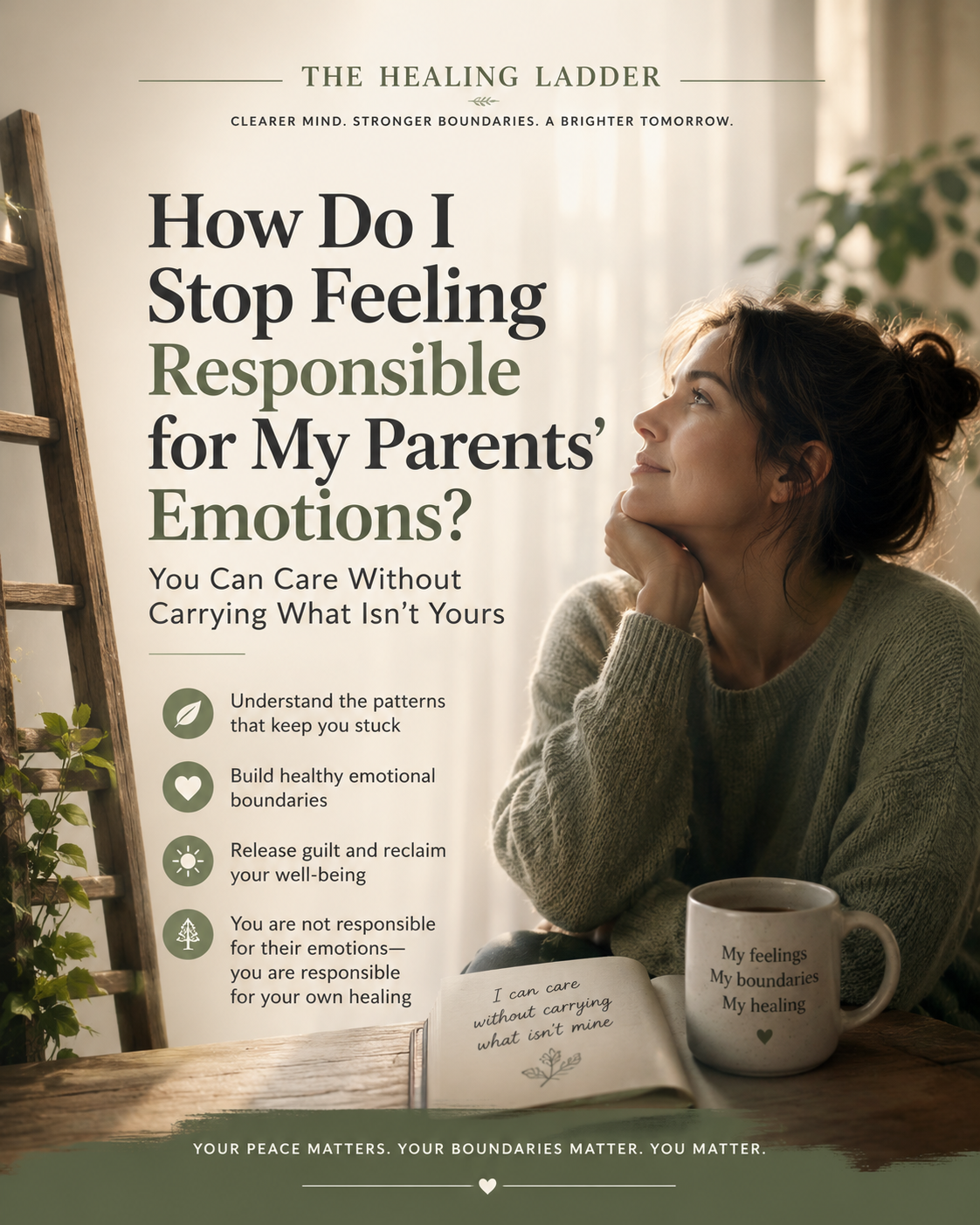
Feeling responsible for your parents’ emotions is a common experience for adults who grew up in emotionally demanding, unpredictable, or unhealthy family environments. Although caring about your parents is natural, believing that their happiness, anger, disappointment, or wellbeing depends on you is different. Research suggests that this pattern often develops in childhood, when children adapt to family dynamics by becoming highly attuned to a parent’s emotional needs. The good news is that this sense of responsibility can change. By understanding where it comes from and learning healthier emotional boundaries, you can care about your parents without carrying the weight of managing their feelings.
If you’ve ever found yourself thinking:
- If I say no, my mother will be devastated.
- It’s my job to keep the peace.
- If my father is upset, I must have done something wrong.
- I know I need boundaries, but I feel guilty every time I set one.
you’re far from alone.
Many adults continue to feel deeply responsible for their parents’ emotions long after childhood has ended. This responsibility can influence decisions about boundaries, relationships, careers, where to live, and even whether to consider low contact or no contact. It often feels less like a choice and more like an obligation.
Yet emotional responsibility is not the same as love.
Understanding that difference is often the first step toward healthier relationships—with your parents and with yourself.
Why Do I Feel Responsible for My Parents’ Emotions?

The short answer is that you probably learned to.
Children are remarkably adaptable. From an early age, they depend on caregivers not only for food and shelter but also for emotional safety. Because of this dependence, children naturally pay close attention to their parents’ moods and behaviors.
In healthy families, children gradually learn an important lesson:
Other people’s emotions belong to them.
Parents comfort children, repair conflicts, and model emotional regulation. Over time, children discover that they can care about others without feeling responsible for fixing every problem.
In emotionally unhealthy families, however, a different lesson may emerge.
A child may learn—directly or indirectly—that keeping a parent calm, happy, or emotionally stable is part of their role.
This doesn’t necessarily happen because a parent intends harm. Many parents carry unresolved trauma, chronic stress, mental health challenges, or emotional immaturity that affects how they relate to their children. Regardless of the cause, the child often adapts in ways that help the family function in the short term but become burdensome in adulthood.
When Caring Becomes Carrying
There is an important difference between empathy and emotional responsibility.
Empathy means:
- Caring that someone is hurting.
- Listening with compassion.
- Offering support when you choose to.
Emotional responsibility sounds different.
It says:
- I have to make them feel better.
- If they’re upset, I must fix it.
- Their emotions are my fault.
- I’m responsible for keeping everyone okay.
This shift is subtle but powerful.
Instead of experiencing relationships as connections between two separate people, you begin experiencing them as emotional obligations.
Psychologists sometimes describe this as poor emotional boundaries, where the line between your emotional world and someone else’s becomes blurred.
Healthy boundaries do not mean becoming cold or uncaring.
They simply recognize that every adult is ultimately responsible for regulating their own emotions.
Childhood Adaptations That Can Follow You Into Adulthood
Many adults who struggle with guilt around boundaries can trace the pattern back to childhood, even if they didn’t realise it at the time.
Research in developmental psychology shows that children adapt to their environments in ways that maximise safety and connection. If a parent’s mood was unpredictable, critical, anxious, or emotionally dependent, becoming highly attentive to those emotions may have helped reduce conflict or maintain closeness.
These adaptations are understandable.
The challenge is that they often continue long after they are needed.
Some common experiences include:
You Became the Peacekeeper
Perhaps arguments stopped when you stayed quiet.
Maybe you learned to smooth over disagreements, apologize quickly, or avoid expressing your own needs.
As an adult, saying “no” may feel emotionally dangerous even when no actual danger exists.
You Felt Responsible for a Parent’s Happiness
Some parents relied heavily on their children for emotional comfort.
They may have shared adult problems, expected reassurance, or implied that their child was “all they had.”
Children naturally want to help.
But when a child becomes a parent’s primary emotional support, the relationship begins to reverse its natural direction.
You Learned That Love Had Conditions
Perhaps affection came more easily when you were helpful, compliant, or emotionally available.
Or maybe conflict led to withdrawal, criticism, silent treatment, or disappointment.
Over time, you may have concluded:
“To be loved, I need to take care of other people’s emotions.”
That belief often survives well into adulthood—even after circumstances have changed.
The Role of Parentification
One concept that helps explain these experiences is parentification.
Parentification occurs when a child takes on responsibilities that are more appropriate for an adult.
Sometimes these responsibilities are practical, such as caring for siblings or managing household tasks.
Other times they are emotional.
Emotional parentification happens when a child feels responsible for meeting a parent’s emotional needs, providing comfort, managing conflict, or acting as a confidant.
Research suggests that children who experience emotional parentification are more likely to struggle later with boundaries, excessive guilt, anxiety, perfectionism, and difficulty recognizing their own needs.
Importantly, parentification exists on a spectrum.
Not everyone who occasionally comforted a parent experienced harmful parentification.
The concern arises when emotional caregiving becomes an ongoing expectation rather than an occasional act of love.
Why Guilt Feels So Powerful
One of the most confusing parts of setting boundaries is how guilty it can feel.
Many people assume guilt means they’ve done something wrong.
But psychology tells us that guilt has more than one source.
Sometimes guilt reflects a genuine violation of our values.
Other times it reflects the breaking of old relational rules.
If you’ve spent years believing that your parent’s emotional wellbeing depends on you, setting a boundary may trigger intense discomfort—not because the boundary is harmful, but because it challenges a deeply learned pattern.
Your nervous system may interpret emotional separation as a threat to connection.
This helps explain why people often experience guilt even when they know intellectually that their boundary is reasonable.
The feeling is real.
But feelings are not always accurate indicators of responsibility.
Attachment and the Fear of Disappointing Your Parents
Attachment theory provides another helpful perspective.
Children are biologically wired to seek closeness with caregivers.
Maintaining that relationship is essential for survival during childhood.
As a result, children become highly sensitive to signs of rejection, anger, or emotional withdrawal.
If expressing your own needs consistently led to criticism, guilt, or conflict, your brain may have learned an understandable association:
My needs create relationship problems.
Years later, simply saying,
“I can’t visit this weekend,”
or
“I’m not comfortable discussing that,”
may activate the same emotional alarm system that developed decades earlier.
Your body reacts as though connection itself is at risk.
Understanding this can be incredibly reassuring.
It reminds us that intense guilt doesn’t necessarily mean we’ve made the wrong decision.
Sometimes it simply means we’re doing something unfamiliar.
Why Your Parent’s Reactions Feel Like Your Responsibility
Many adults notice a familiar pattern.
They set a respectful boundary.
Their parent becomes angry, hurt, disappointed, or tearful.
Almost immediately, they begin wondering whether they should apologize, explain themselves again, or withdraw the boundary altogether.
This reaction is understandable because humans naturally respond to emotional cues from people they love.
But there’s an important distinction between influencing someone’s emotions and being responsible for them.
Every relationship involves influence.
A difficult conversation may leave someone disappointed.
A declined invitation may lead to sadness.
A disagreement may create frustration.
Influencing another person’s emotions is unavoidable.
Taking ownership of regulating those emotions is something else entirely.
Healthy adult relationships allow space for both people to experience uncomfortable feelings without expecting the other person to erase them.
That can feel unfamiliar if you grew up believing that harmony depended on your ability to keep everyone emotionally comfortable.
How Do I Stop Feeling Responsible for My Parents’ Emotions?
Changing a lifelong pattern doesn’t happen by convincing yourself to “stop caring.” Most people who feel responsible for their parents’ emotions are deeply caring individuals. The goal isn’t to become indifferent. It’s to develop a healthier understanding of where your responsibility begins and ends.
Research on emotional regulation and healthy relationships suggests that change often starts with awareness rather than dramatic action. As you begin recognising old patterns, you can gradually respond differently.
Here are several approaches that many people find helpful.
1. Separate Compassion From Responsibility
One of the most helpful questions you can ask yourself is:
“Can I care about this without believing it’s my job to fix it?”
Compassion allows you to acknowledge another person’s feelings.
Responsibility assumes those feelings are yours to manage.
For example:
- “I understand that my mother is disappointed.”
is different from
- “I have to change my plans so she won’t be disappointed.”
The first statement recognizes her emotional experience.
The second assumes ownership of it.
This small shift can feel surprisingly powerful over time.
2. Notice the Stories Behind Your Guilt
When guilt appears, it often brings automatic thoughts that have been reinforced for years.
You might notice beliefs such as:
- A good daughter never says no.
- A loving son always puts family first.
- If they’re upset, I’ve failed.
- It’s selfish to prioritise my own wellbeing.
Rather than accepting these thoughts as facts, try approaching them with curiosity.
Ask yourself:
- Where did I learn this?
- Is this belief helping me today?
- Would I expect another adult to live by this rule?
Many people discover that the standards they apply to themselves are far stricter than those they would apply to anyone else.
3. Remember That Discomfort Is Not the Same as Harm
One of the biggest misconceptions about boundaries is that they should never upset anyone.
In reality, healthy boundaries sometimes create discomfort.
A parent who is accustomed to unlimited access may feel frustrated when you begin saying no.
A parent who relied on you for emotional reassurance may feel disappointed when you stop filling that role.
Those feelings are real.
But they are not necessarily evidence that your boundary is wrong.
Healthy relationships allow room for disappointment without requiring someone to abandon their own needs.
4. Practise Tolerating Their Feelings
This can be one of the hardest parts.
When a parent reacts with anger, sadness, or guilt, your nervous system may immediately urge you to make everything better.
Instead of responding automatically, consider pausing.
You might remind yourself:
Their feelings deserve respect. They do not require my rescue.
That doesn’t mean ignoring someone who is genuinely struggling.
It means recognizing that another adult’s emotional experience belongs, ultimately, to them.
Learning to tolerate this discomfort is often part of building healthier emotional boundaries.
What If My Parent Uses Guilt to Change My Mind?
Some parents accept boundaries with time.
Others continue to challenge them.
You may hear comments like:
- “After everything I’ve done for you.”
- “You’ve changed.”
- “I guess I don’t matter anymore.”
- “You’re breaking this family apart.”
Hearing these words can be incredibly painful.
It’s natural to question yourself.
At the same time, it’s worth remembering that guilt and responsibility are not the same thing.
Someone may genuinely feel hurt by your decision.
That doesn’t automatically mean your decision is unfair.
Healthy relationships allow people to express difficult emotions without expecting those emotions to determine another person’s choices.
Sometimes the most compassionate response is simply acknowledging the feeling without abandoning the boundary.
For example:
“I understand that this is difficult for you.”
rather than
“You’re right—I should change my decision.”
Empathy and boundaries can exist together.
What Does the Research Say?
Although every family is unique, several areas of psychological research help explain why learning healthier emotional boundaries can improve wellbeing.
Studies on family systems theory suggest that healthier relationships depend on recognizing each family member as a separate emotional individual rather than expecting one person to regulate everyone else’s feelings.
Research on self-differentiation, developed through family systems psychology, has found that people who are better able to maintain their own thoughts, values, and emotions while staying connected to others often experience lower levels of anxiety and healthier relationships.
Studies on attachment also suggest that developing greater emotional security involves learning that closeness does not require abandoning yourself.
Meanwhile, research on chronic stress shows that constantly monitoring other people’s emotions can keep the body’s stress response activated over long periods. Feeling responsible for preventing conflict or disappointment may contribute to ongoing emotional exhaustion, hypervigilance, and burnout.
Taken together, these findings support an encouraging idea:
Healthy boundaries are not about becoming less loving.
They’re about creating relationships where everyone’s emotional wellbeing matters—including yours.

Does This Mean I Should Distance Myself From My Parents?
Not necessarily.
Realizing that you are carrying too much emotional responsibility doesn’t automatically point to one specific solution.
Some people find that small, consistent boundaries improve their relationships.
Others discover that reducing contact creates the space they need to heal.
In situations involving ongoing emotional abuse, manipulation, or repeated violations of boundaries, some adults eventually decide that low contact or no contact is the healthiest option.
For others, maintaining a relationship while changing long-established patterns feels both possible and meaningful.
There is no universal answer.
The healthiest decision depends on the nature of the relationship, your emotional safety, your wellbeing, and your individual circumstances.
The goal is not to follow someone else’s path.
It’s to make decisions that align with your own values and reality.
Healing Takes Time
Many adults hope that once they understand these patterns, the guilt will disappear.
Unfortunately, emotional habits that developed over decades rarely change overnight.
You may still feel anxious after saying no.
You may still worry about disappointing your parents.
You may still question whether you’re being selfish.
That doesn’t mean you’re moving backwards.
Growth often involves feeling familiar emotions while making different choices.
Over time, many people notice that the guilt becomes less intense, the boundaries feel more natural, and their decisions are guided less by fear and more by intention.
Healing is rarely about becoming someone entirely different.
More often, it’s about gradually returning to the parts of yourself that were always there beneath years of obligation.
Frequently Asked Questions
Is it normal to feel guilty when I stop taking care of my parents’ emotions?
Yes.
Many adults experience guilt when changing long-established family roles. Guilt often reflects the breaking of old expectations rather than evidence that you’ve done something wrong.
Does setting boundaries mean I don’t love my parents?
No.
Healthy boundaries are compatible with love, compassion, and respect. They simply recognize that caring for someone does not require sacrificing your own emotional wellbeing.
Why do I feel anxious when my parent is upset with me?
If you grew up in an environment where conflict felt unsafe or unpredictable, your nervous system may still respond strongly to signs of disapproval. Understanding this response can help you separate past survival patterns from present-day relationships.
Can I care about my parents without feeling responsible for them?
Yes.
In fact, many healthy relationships are built on exactly this balance.
You can listen, support, empathize, and remain connected while recognizing that each adult is ultimately responsible for managing their own emotions.
Final Thoughts
Feeling responsible for your parents’ emotions doesn’t mean you’re weak, overly sensitive, or incapable of setting boundaries.
More often, it reflects the ways you adapted to your family environment while growing up.
Those adaptations may once have helped you maintain connection or reduce conflict.
But adulthood offers the opportunity to build relationships based on mutual respect rather than emotional obligation.
Learning that another person’s feelings are not yours to manage doesn’t mean you stop caring.
It means making room for a different kind of care—one that includes compassion for yourself as well as for others.
As you begin separating empathy from responsibility, you may discover that healthy boundaries don’t diminish love.
They simply allow it to exist alongside honesty, respect, and emotional freedom.
Continue Reading
If this article resonated with you, these guides may also help you explore related questions:
Leave a Reply